Today in England, Wales and Northern Ireland is GCSE results day and it comes with a reminder for me about the difference between knowing vs trusting or hoping, that your children are OK, no matter what the results.
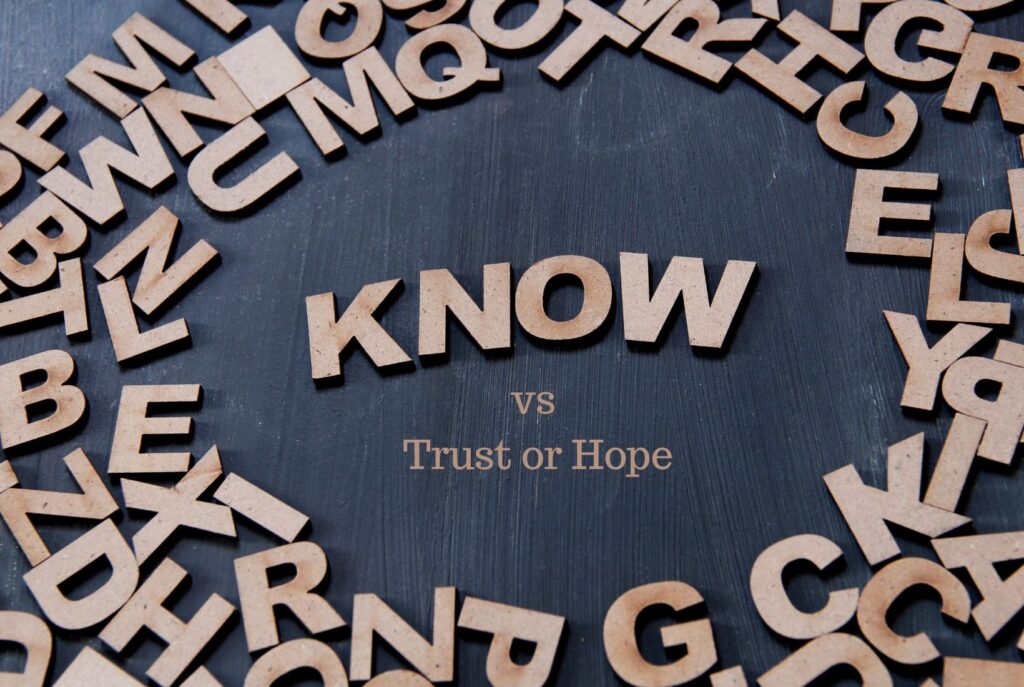
What Is Trust Or Hope?
It looks to me like trust and hope are both based on some future-based narrative, event or thing outside of oneself.
I’ve always had a bit of an issue with trust. It meant placing something to do with ‘me’ in the hands of something or someone else and hoping it would work out. Being a self-confessed control freak (and let’s face it, if you’re human you probably like to feel you’re in control), this did not feel comfortable.
And it’s the same with ‘hope’. Looking to an imaginary future where ‘everything will be OK’. Not for me. Again, to me that relies on wishing something to be different from how it is. And that’s not to say that I can’t see the power of hope for so many people but it misses a very large fact.
What Do Trust & Hope Miss?
When it comes to trust and hope there is an elephant in the room.
Because when we look to what’s true, not what the mind has to say through thought about what’s true, we see that there is absolutely nothing ‘wrong’ with This.
The only thing ‘wrong’ with this moment – with these exam results – with this body – with this experience – is what the inner narrator (or ‘Bob’ – the name I use for that) has to say about it.
And when you notice what that is saying, you’ll also notice that what it’s saying is not ‘yours’, but rather something you’ve innocently acquired. A belief or idea that did not exist when you entered the world but which has been absorbed from the people and society that you find yourself surrounded by. Through no choice of your own.
How Is Knowing Different?
When you’re relying on trust or hope can there be doubt? In my experience there certainly was for the reasons outlined above.
When you KNOW something, is there doubt?
When sailors in the past came to KNOW that the world wasn’t flat, they no longer put their anchor out when they reached the ‘middle of the ocean’ thinking they’d fall off the world if they didn’t. Their behaviour changed. They didn’t have to persuade themselves not to do that. They just knew they didn’t need to any more.
When you found out that Father Christmas didn’t exist, you didn’t have to keep reminding yourself that he wasn’t real. And you stopped relying on him to bring you presents on Christmas day.
When you KNOW yourself as that which is aware of it all, rather than the body or the mind or ‘ego’ or identity (which are always changing), there is no requirement to rely on ‘hope’ or ‘trust’.
Because you KNOW you are OK. Always.
Aware of the thoughts about ‘good’ or ‘bad’ exam results, aware of the child in front of you who is ‘sad’ or ‘happy’, aware of the feelings of anger or joy, aware of the sounds of people around you, aware of whatever is appearing right here, now.
What Changes With Knowing?
And that changes the experience of life. No longer dependent on things going ‘right’ or ‘well’ (because let’s face it, we’re human and that entails experiencing everything), life can just be lived.
With the fear.
With the worry.
With the ‘sad’ or ‘happy’ child.
Knowing that all those things are experiences known to you, the awareness of it all.
And the incredible thing is, is that when you know this for yourself, you know that the same applies for every other human on the planet. All of us are simply, effortlessly, aware. When that awareness focuses on something (like ‘bad’ exam results), there can be the appearance of struggle or difficulty in the human. But that focus always moves, and then, so too, does the experience.
Explore With Me
If you’d like to explore this for yourself my book The Truth Beyond Thought; Experiments To Rediscover Peace & Freedom is a good starting point.
And if you’d like to have a conversation about this with me after reading that then book a free exploratory call.
Leave a Reply